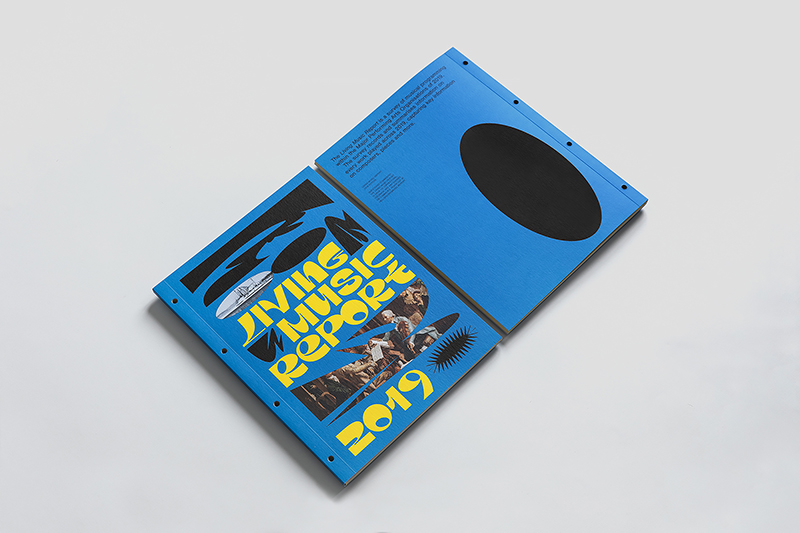
The Living Music Report is a survey of programming within Australia’s Major Performing Arts Organisations, analysing the representation of minority groups—spanning gender, First Nations, and culturally and linguistically diverse communities. The report exists to unpack historical programming data, with the goal of fostering greater equity and inclusion across the national arts sector. The aim was to develop a visual identity and system that translated this typically dry content into something bold, contemporary, and engaging—helping facilitate meaningful conversation.
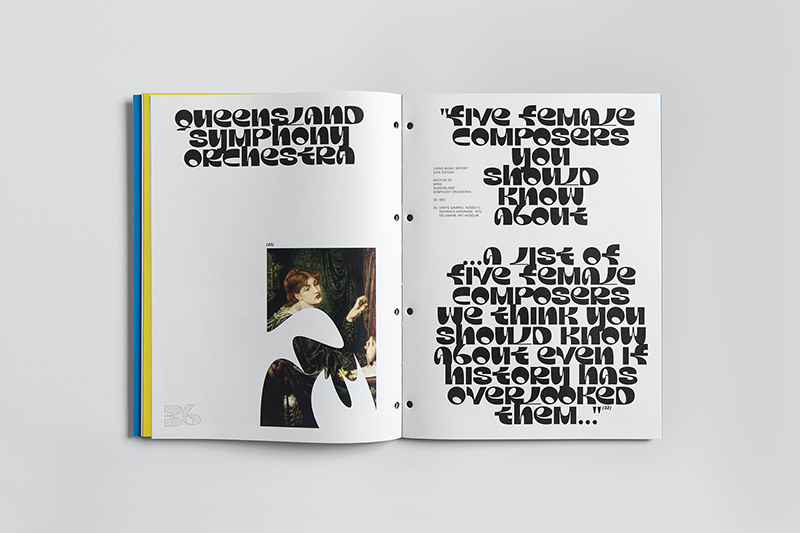
Inspired by the report’s function as both a prompt and a tool for change, the identity leans into vibrancy and rhythm. A custom typeface—drawing on the expressive curves of musical notation—anchors the system, supported by a palette of bright tones and dynamic gradients. These gradients speak to change and fluidity, reinforcing the idea that the data reflects a moment in time, not a fixed reality. Through this expressive yet structured system, the identity brings clarity and urgency to the report’s findings—encouraging transparency, reflection, and forward momentum.
The Living Music Report is a survey of programming within Australia’s Major Performing Arts Organisations, analysing the representation of minority groups—spanning gender, First Nations, and culturally and linguistically diverse communities. The report exists to unpack historical programming data, with the goal of fostering greater equity and inclusion across the national arts sector. The aim was to develop a visual identity and system that translated this typically dry content into something bold, contemporary, and engaging—helping facilitate meaningful conversation.
Inspired by the report’s function as both a prompt and a tool for change, the identity leans into vibrancy and rhythm. A custom typeface—drawing on the expressive curves of musical notation—anchors the system, supported by a palette of bright tones and dynamic gradients. These gradients speak to change and fluidity, reinforcing the idea that the data reflects a moment in time, not a fixed reality. Through this expressive yet structured system, the identity brings clarity and urgency to the report’s findings—encouraging transparency, reflection, and forward momentum.